
“Everywhere is walking distance if you have the time” – Steven Wright
In 1846, my fifth-great grandmother walked from Nauvoo, Illinois to Salt Lake City, Utah, a distance of 1300 miles. Her purpose: attend church. She was joined by the eight children for whom she was responsible and a single ox-drawn wagon that carried supplies necessary to start a new life out west.
Five generations later, my family also travels in order to attend church – a grueling half mile drive down a paved road, seated in an air-conditioned cabin. On occasion, we contemplate the idea of walking to church like my grandma did, but the daunting thought of chasing a three-year-old down the sidewalk of a busy street while pushing our infant in a stroller is often just too much to handle.
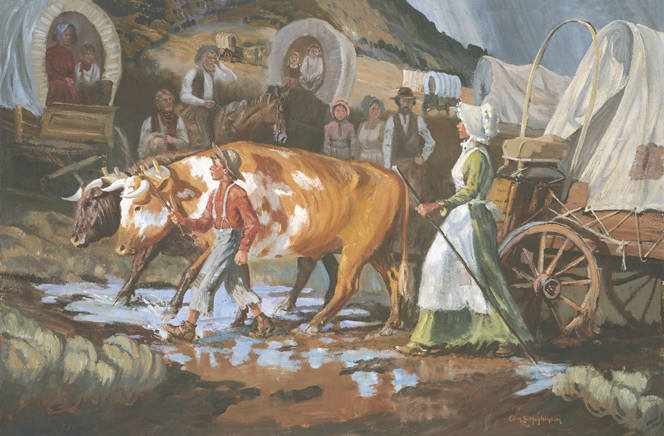
For thousands of years, our legs held a convincing monopoly on the transportation of human bodies and cargo. Whether you were crossing the kitchen or the Sahara Desert, you did it on two feet. Naturally, we grew tired of all this physical exertion and started developing ways to cheat the system. We invented the wheel, the axle, the bridge. The horse was harnessed; the internal combustion engine invented. We dug oil out of the ground and captured the sun’s energy.
Today, our own two legs have been mostly bought out of the transportation market, swiftly replaced by the wheel and wing. And why not? It’s so easy! Just hop in your car and you are at your destination in no time without even breaking a sweat. In America, you have the right to travel wherever you want as fast as you can (within reason) and as often as possible as long as you can pay for it.
The cost of easy transportation is counted in more than just dollars, however. In 2017, America burned through 20 million barrels of oil per day and generated 4 million pounds of carbon dioxide per day all in the name of transportation, pushing us ever closer to the bottom of the last oil barrel and slowly inching up the Earth’s thermostat [1][2]. Nervously we glance towards the future, mostly ignoring the problem while clinging desperately to new energy sources (compressed natural gas, ethanol, bio-diesel, electric cars) that might just save the automobile.
Honestly though, the car is a bad idea no matter where you get the energy from. When driving in the city, gasoline-powered cars convert only 16% of your fuel’s energy into actual movement [3][4]. This is perhaps why car manufacturers report “miles per gallon” instead of “thermodynamic efficiency.” Electric cars are a definite improvement with 30% efficiency (assuming a natural gas powered power plant) [5], but that’s still not the full story. The average American car weighs 26 times more than you do [6] which means an electric vehicle carrying one person in city driving is using only 1.2% of the fuel’s energy to actually move that person’s body. A gasoline-burning engine is even worse, using only 0.6% of its fuel to move your body. Cars also require a significant amount of space to operate, resulting in 27,000 square miles of paved roads in the United States which is about the size of West Virginia [7][8]. There are 3.4 parking spaces per car in this country [9]. Cars move very fast and are piloted by imperfect humans, resulting in 40,100 American deaths in 2017 and injuring 4.5 million people [10].
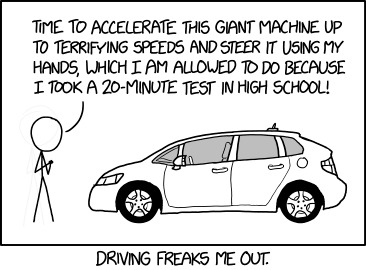
The answer to our problems really isn’t that complicated, it’s just not the answer we want to hear – we need to use our legs more and travel less. Often a car is a necessity to get where we need to go, but we don’t always have to drive, especially to cover a distance that we could walk or bike. Driving is a luxury and should be treated as such.
Unfortunately, we appear to have forgotten that travelling with our feet is even an option. On my daily bike ride to school I always pass a small crowd of college students waiting for a shuttle to drive them a mere five blocks to campus. I pass many students getting into their cars with their backpacks, prepared to make the harrowing half mile drive so that they can make it to class on time. Only 4.5% of the population commutes to work via walking or biking, whereas 76% of us drive alone [7].
For most of us, walking and biking appear to be out of the question because everything is so spread out. To be fair, things really are spread out, making a car all but necessary. But, you don’t always travel as far as you think. Half of American vehicle trips are less than 10 miles and 20% of all of our car trips are less than a single mile [11]. If, as a country, we decided to walk or bike just half of our one mile car trips, we would save 10 billion miles of driving in a single year [12]. That might still seem far, but the average American already takes 4,700 steps per day, working out to about 3 miles [10]. Not bad! You might be concerned about time, but it only takes me 10 more minutes to bike three miles to school as compared to driving. And, honestly, we could do with slowing down a little bit.
That brings me to my next point. The car is a moving fortress, designed to protect your body from the elements. As a result, we are removed from the land that we travel over, catching only glimpses as the landscape flashes before us, our eyes focused on the road. The car also protects us from ourselves, getting us to our destination fast while playing music or podcasts so that we don’t have to spend too much time with our own thoughts. There is much to be gained by removing ourselves from this fortress and taking the time to travel deliberately, focusing on the world around us and our own internal dialogue. I walk three miles to school about once a month and it is often my favorite part of the day. I have time to meditate and often literally stop to smell the roses. Why should I be in such a hurry to sit behind a desk? Here are some pictures from my monthly walk to work!



Walking and biking aren’t options for all of us – you might have kids, live in a rural community, or the weather really is that bad (the list goes on). However, you can still reduce the number of miles you drive by simply driving less. How many car trips that you made in the last week were necessary? Can you combine multiple trips into one? Could you carpool? Do you need to go quite so far? Efficient planning, good communication and good old restraint are as effective as the road bike in reducing miles driven.
The car is not going away, and I’m not suggesting that it should; we are too far down the road to ever look back. But we don’t have to surrender to the automobile, crowning it as the sole method of human transportation. The car is a tool – a device to be used with careful planning, finesse, and an appreciation for the resources it consumes. When used in conjunction with more efficient transportation methods (including public transportation) as well as conservation-based lifestyles, the automobile is useful and constructive.
Safety is the hold up for most of us and for good reason. My bike is small and insignificant compared to the iron tanks that I share the road with. But every person on foot or on bike is a person not in a car. As we ease off the miles we make it easier to transition to foot-based travel. We just need some pioneers to blaze the way! Just remember these safety tips:
- Make yourself visible. Reflectors, flashy lights, bright clothes.
- DON’T put in ear buds while biking or even walking. An engaged pedestrian is an alive pedestrian.
- FOLLOW THE RULES OF THE ROAD. I have seen more traffic violations by bicyclists than any other group of people. If you are sitting on your bike then you are a vehicle so you better act like one! People aren’t going to start riding bikes if they keep almost running them over.
I usually try to end these posts on a positive note, but I’m feeling a bit pessimistic today. In America, 29% of our total energy consumption is already dedicated to transportation and that number is growing fast [8]. Our cities are spread out and our culture has all but abandoned truly efficient transportation. So, I turn to you, the reader. What are your ideas? How can we change?
 Joule Thieves