
The second law of thermodynamics is both very simple and very complicated. Many of us understand the basic premise of the law, explained to us through the use of messy bedrooms, marbles in a jar or failed high school romances, but we don’t always see how the basics of the law apply to physical processes. I’ll start by explaining the basic idea of the law and then show you how the law applies to physical processes that actually mater.
We will start with an example. You have recently inherited 10 llamas from your grandma’s wool farm. Five of the llamas have been died blue (because who doesn’t want blue llama wool?) whereas the other five are still just boring llama color. Because you are an organized person, you unload all of the blue llamas on the right side of the field and all of the boring llamas on the left side of the field and then leave them there to graze happily.
The next morning you go out to the field only to find that they are now all disorganized! The nerve of these llamas! In your anger, you sort them out again, only to find them disorganized again the next day. Time and time again you sort to only find that your llamas prefer to be disorganized. Really, you can’t blame the llamas; it is much easier for them to be disorganized. To maintain a state of organization would require more work either from them or yourself, and nature always takes the path of least resistance.
Your disorganized llamas have illustrated a very important concept, otherwise known as the second law of thermodynamics.
All physical processes tend towards disorder
To explain why this happens, we have to think about all of the possible ways the llama’s could arrange themselves in your field. I have pictured 6 possible arrangements below, where one arrangement is what you want (blue on right, others on left) and the other five are arrangements you don’t want. If you do the numbers, there are way more possible disorganized arrangements than organized arrangements. Since only one arrangement can exist at a time, it is very likely that the current arrangement will be a disorganized one. It is possible that the llamas could arrange themselves into an organized fashion, but I think that is giving them a little too much credit.






We can apply this concept to any number of analogies, such as my bedroom. I like my room to stay organized – the bed is made, all of the clothes are in specific drawers and there isn’t any dirt on the floor. However, there are lots of places where the clothes could be, such as on the floor, and it is easier to throw my clothes on the floor than to sort them and put them into specific drawers. So, naturally, my clothes end up on my floor, just like the sheets on my bed end up in one of many possible messy arrangement, not the nice single organized arrangement I prefer.
But how does this apply to how we use energy? Energy comes in many different forms with varying degrees of disorder. A barrel of oil, for example, is very organized (all of the atoms are stuck in chemical bonds) but a barrel of hot air is very disorganized (the atoms are bouncing around all over the place! What a mess!). As a civilization, we love organized forms of energy for a variety of reason:
- Organized energy can be moved easily from place to place. If you have organized energy you can store it and move it around until you are ready to use it. Gasoline pumped into your gas tank will just sit there happily, waiting to be exploded inside of your engine.
- Organized energy is (relatively) easy to harvest. To gather organized energy, all you have to do is cut down a tree or dig some coal out of the side of a hill. We have been using energy in these organized, easy-to-harvest forms for thousands of years.
- You can turn organized energy into disorganized energy. You can do a lot with a gallon of gasoline. You can set it on fire to make yourself warm, put it into your car to drive around, put it in a generator and turn it into electricity or even process it into a hunk of plastic. Hot air, on the other hand, can only make you warm.
- Organized energy is ultra-concentrated. A 42 gallon barrel of oil has 6120000 kJ of energy which is about enough to run a 1000 W light bulb for 10 weeks straight. You would need 153,292 barrels of air at atmospheric pressure and room temperature to have that same amount of energy [1]. Organized energy is very compact.
So, we definitely prefer organized energy – the problem is nature does not. It is very easy to get the organized energy into a disorganized state (just set the barrel of oil on fire, for example) but it is impossible to turn the resulting hot air back into a barrel of oil through a naturally-occurring process because nature just doesn’t run that way.
Of course, humanity is clever and has found ways to turn disorganized energy into organized energy. But, it does so at a cost. A coal power plant, for example, turns really hot steam (heated by the coal) into electricity. BUT, only a certain percentage (called the ‘efficiency’) of the energy released by the coal will be turned into electricity. The rest will remain as hot air, unused. The best efficiency we have for a fossil-fuel burning power plant is around 50% [2]. The average is around 40% [3].
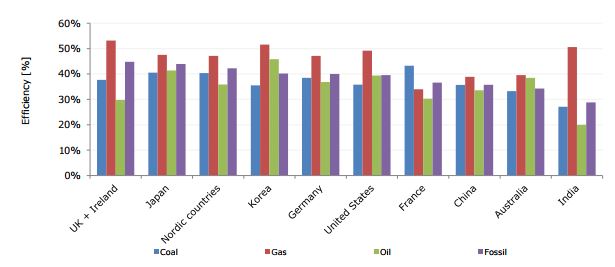
Hearkening back to the first law of thermodynamics, when you set a barrel of gasoline on fire, you are not destroying energy – the amount of energy is the same between the barrel of oil and the hot air you have created once the oil is done burning. However, the usefulness of the energy has been destroyed. Now, instead of having very useful organized energy in the form of gasoline we just have a lot of hot air and there’s no way to turn it back into oil.
This matters to you because organized energy is becoming harder to come by. Oil used to gush out of the ground in Texas [4] but now we have to drill miles and miles into the Earth’s core over the Gulf of Mexico. Coal and natural gas are likewise just as finite. Nature’s naturally-occurring organized energy resources (wind, sunshine, plants) are great but they are not nearly as concentrated as a barrel of oil. As such, we have to ask ourselves the question: how much sustainable energy can we reasonably extract from our surroundings?
 Joule Thieves