
Before we begin, let’s get something straight – I think solar energy is great. If I actually owned a home and had piles of cash to go with it I would cover my rooftop in solar panels tomorrow. However, I am not a home owner and I’m a graduate student (i.e. not wealthy) so those solar panels are going to have to wait until I catch that big break. Such is life.
For many of us, solar energy appears to be the answer to all of the world’s problems. We read all of these scary news articles about changing weather and mass extinctions and say “If I could just buy those solar panels than all of the world’s problems would go away!” However, before you bet the farm on those solar panels to keep the American lifestyle alive and well, I think it is very important that we understand solar energy’s limitations. Specifically, we need to understand the vast number of solar panels that we would need to power America. As such, I ask this question:
What state will we have to cover in solar panels to power the United States?
Elon Musk, the CEO of Tesla and SolarCity, has been spouting off an answer to this question for a while now [1]. His answer – a small square in Utah or Nevada measuring 100 miles by 100 miles and a giant block of batteries to back it up. Given that Mr. Musk sells solar panels (and batteries), you would assume that his answer is probably too big. However, I am quite convinced that we are going to need way more. Let me run you through the numbers:
First we have to consider what it means to “power the United States.” In his answer, Elon Musk takes that to mean we must generate, with solar panels, the total amount of electricity that the United States currently consumes. The way I look at it, a nation in the future that generates all of its electricity using solar energy has probably run out of easy-to-get fossil fuels. In other words, we are going to have to supply all of the energy that we currently use in the United States with solar energy. This includes energy used for electricity, transportation (cars, motorcycles, planes, boats, hoverboards), heating, manufacturing, etc. Of course, right away we can tell that my answer is going to be bigger than Elon’s, but I am just trying to be realistic. If we want to take fossil fuels out of the equation, we have to take them all the way out.
So, lets answer this question: How much energy does the United States use? Remember, this is total energy used, not just electricity (see What is Energy? to understand this point better). The per person total energy use in 2015 for the United States was 87,216 kWh of energy [2]. If we multiply this number by the total number of people in the United States in 2015 (approximately 320 million [3]) then we will get the total amount of energy used in the United States in 2015, or 28 Trillion kWh of energy! Since this number is probably meaningless to you (as it is to me), this is the same as detonating about 1.7 million atomic bombs in one year.
To complicate things, electricity disappears about as fast as you make it, so all of this energy needs to be created on demand (or close to it). True, you could store electricity for later use in a bank of batteries, but it would take a huge mountain of batteries to store even a fraction of our total energy usage. A Tesla battery, for example, stores about 100 kWh of energy [4], which means that one million Tesla batteries would only store about 0.0004% of the total energy that we use in one year. As such, we will assume that all of the energy that we use in one day must be created on that same day. To simplify things we are going to assume that the country of the United States will use about the same amount of energy on any given day. I’m sure lots of people will scoff at this assumption, but remember we are talking about total energy consumption, not just electricity. Electricity use peaks in the summer time and is lower in winter time mostly because of air conditioning [5]. However, natural gas use peaks in the winter time and is low in the summer due to residential heating [6]. Everything else (driving, factory production, etc.) we are going to say is fairly constant. So, that means we need to produce 28 trillion kWh / 365 days = 75 billion kWh per day.
So, how many solar panels do we need to meet that demand every day? Well, it’s complicated. First we have to understand that the amount of solar energy that hits your rooftop changes depending on where you live and the time of year. As I show in the image below, when the sun is directly over your head the maximum amount of energy hits your solar panel. However, as the sun moves away from this position (as shown on the right) then less energy hits the same sized panel. So, in the winter time solar panels collect less energy because the sun isn’t as high in the sky as in the summer time. Likewise, if you live really far north, say in Alaska, then the sun also doesn’t get as high in the sky as compared to Southern California. Of course, this can be corrected by tilting your solar panels, but that means you collect a little less in summer time. Man, we just can’t win! Finally, in the winter time there are fewer day light hours, which means there is less energy for solar panels to collect. So, long story short, we need enough solar panels to collect 75 billion kWh in one day in the middle of winter. Stick with me, we are almost there.

Next, how much solar energy hits the Earth’s surface in January? Some really smart people got together and answered this exact question using math and satellites. Here is the map that they came out with [7]. Here is a fun interactive version of this same information.
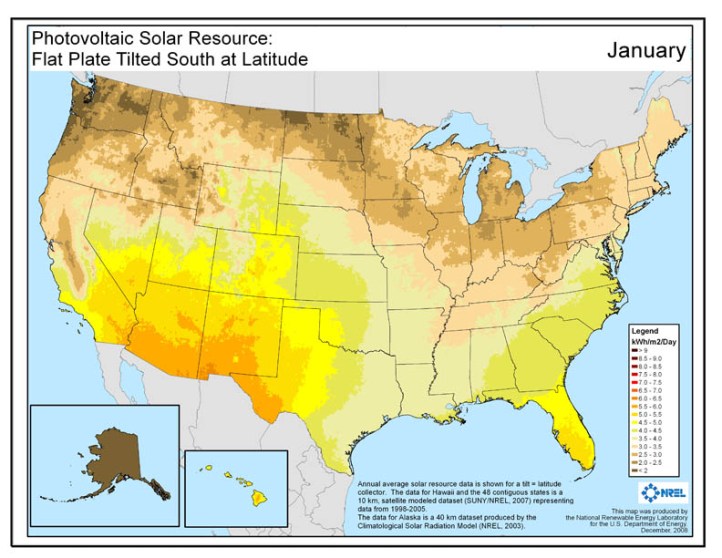
They have given us the total number of kWh (energy) that hits a flat plate tilted south measuring 1 meter by 1 meter over the course of one day. Perfect! Thank you science! Right off the bat we are tempted to say “Great, lets put all of the solar panels in that nice orange place in Southern Arizona.” After all, that’s what Elon said. But you can’t just move electricity around for free. Every 100 miles you lose about 1% of the electricity in those lines [8]. So, a distance of 2400 miles (from Tucson AZ to New York City) isn’t looking too good. Anyway, we are talking about you putting solar panels on your house and I highly doubt you l[10]ive in Tucson, AZ (and if you do, I’m sorry). Instead, we will use the average value for the whole United States. For this average we will be very generous and say 5 kWh per square meter per day.
But wait! That’s not all! A solar panel only collects a portion of the energy that falls on it, otherwise known as its efficiency. This is a real hot topic with lots of active research [9]. To be safe we will say our solar panels have an efficiency of 20% and I honestly don’t have the room to argue this point, so bear with me on this one.
Alright, we are ready! To find the amount of solar panel area we need (in square meters) we just take the total energy required and divide by the amount of energy that hits one square meter multiplied by our collection efficiency. And the result?
75,000,000,000 Square Meters = 29,000 Square Miles
Dang that’s a lot. To be fair, Elon Musk’s estimate came in at 10,000 miles, so I guess we aren’t that far off after all. To give you context, 29,000 square miles is equivalent to basically all of the land mass in South Carolina [10].
Honestly, I still don’t trust this answer. You see, we used an average value for the amount of energy that will hit your solar panel in January. What if we have three consecutive days of snow over half of the country? That will bring our energy output way down. Likewise, we assumed that the power consumption will be exactly the same every day. In reality there will be fluctuations in the amount of energy needed at any point in time and it is very possible for that need to spike. At this point it becomes hard to speculate on the additional number of solar panels we will need to install. As such, we aren’t going to try. Just know that South Carolina is a lower limit.
Just for fun, lets do the energy consumption of the whole entire world but with a few twists. First, we are going to give everyone in the world the same lifestyle as an average American. This is of course ridiculous, but isn’t that what we are shooting for? Lifting people out of poverty by definition means that they consume more energy. The amount of energy hitting the entire Earth is shown below. For this case I have done a yearly average, mostly because winter and summer happen at the same time depending on which hemisphere you are in. Just glancing I’m again going to say that 5 kWh per square meter per day is the daily energy input averaged over the whole earth. The biggest mistake we are going to make is by using the current global population (7.5 billion). In reality, a world powered entirely by solar is going to have many more people in it because it is in the future.

Running the numbers just like we did before, we now have:
690,000 Square Miles!
Hopefully you weren’t planning a visit to Libya anytime soon because we just covered it in solar panels.
My whole entire point in writing this post is to show you that there are several parts of the equation that control how many solar panels we will need. Improving efficiency and placing our panels in regions with lots of sun will definitely help improve our situation, but the most important variable, by far, is the amount of energy that we need to generate. A holistic approach to our energy problems must include a drastic reduction in energy consumption, but that’s not the one we talk about the most. Improving panel efficiency is easy because it doesn’t require you to give up anything. But changing a lifestyle…
 Joule Thieves
![[7]](https://www.nrel.gov/gis/images/map_pv_us_january_dec2008.jpg)
Loved this! As you know, I am not your average energy consumer. There are many more energy hogs out there like me. So I would say, to just cover the land of enchantment for added measure. It’s better to have too much than not enough when it comes to electricity.
LikeLike
Major quibble: 29,000 square miles sounds like a lot, but it might be easier to restate it as 1% of the land mass of the lower 48 states. By contrast, http://www.helgilibrary.com/indicators/agricultural-land-area/ claims that the US has over 4 million square km of agricultural land (1.5M mi^2), about half the land area of the US! It’s not so unreasonable to consider energy as another “crop” that needs to be farmed in the most suitable land.
LikeLike
I completely agree that 29,000 square miles really isn’t that much compared to crop area. I’ve been thinking about this more after publishing this post, and I’m starting to think that the biggest problem with centralized panels in a given section of the country would probably be political. Who would own the panels? Who would gain the revenue from the sale of the electricity? The nice thing about crops is ownership is spread across a large number of people. I would worry about a centralized government owned utility…. You make a valid point though.
LikeLike
I agree, it would be better if it were decentralized. Hopefully the energy market naturally moves toward this, and I think it will (hopefully with some help from the gov’t).
I definitely appreciate the point that most people don’t realize the vast amounts of energy we’re already consuming. I just wanted to point out that it isn’t that absurd to put such a large amount of land toward it.
LikeLike
Amen. We are definitely going to have to put a lot of land towards it regardless of what we do. I like the comparison to crops because they are very similar.
LikeLike