
“Everything in excess is opposed to nature”
-Hippocrates
If humanity and fossil fuels were friends on Facebook, their relationship would be listed as “It’s Complicated.” Fossil fuels, the hero of 20th century America, have been accused of changing the weather in a bad way but they have become such an integral part of our daily life that we aren’t sure how to give them up. As a result, we can’t agree on the best path forward. Some of us want to sacrifice fossil fuels on the altar of human progress and proceed in some unknown direction. Others are quite convinced that this is just some giant scientific misunderstanding (or conspiracy theory) and want to continue as usual. Most of us sit somewhere between these two extremes, cheering for one side or the other but really just hoping that the TV stays on.
Honestly, I really don’t care if you “believe” or “don’t believe” in climate change. I’m not writing this post to try and convince you either way. The whole climate change debate has become a bit too heated (ha, get it) for my poor, peace-loving soul to handle. Not to mention battle lines have been clearly drawn along partisan boundaries, and in my mind that means there will be very little actual progress made. Instead, I hope to show you that fossil fuels are not inherently good or bad – they are simply a tool that should be used wisely. And, to be blunt, our current rate of fossil fuel consumption, combined with one obvious but lately neglected fact, combine to make our current usage very unwise.
But, before we get into the heavy stuff, we need to understand some really cool things about fossil fuels.
Fossil fuels are nature’s energy savings accounts. For a very long time now the sun has sent energy (see What is Energy?) our way in the form of thermal radiation. Most of that energy has either been reflected away or emitted by the Earth back into space. However, a very small fraction of that thermal energy has slowly been collected by the trees, bushes, weeds and plankton of the Earth and transformed, through photosynthesis, into chemical potential energy [3]. Some of these plants were eaten by animals, which were eaten by other animals, etc. A long time ago some of these plants and animals got stuck in some mud and were buried deep in the earth. Those remains were heated and squished for a long time, concentrating the energy into a gas (natural gas), liquid (crude oil) or solid (coal) form.
Long story short, fossil fuels are super-ultra-concentrated solar energy in a physical form. And when I say concentrated, I mean really concentrated. You would need 53 pounds of fully-charged lithium-ion batteries to match the amount of energy present in just one pound of standard-issue gasoline [4]. To illustrate, a Tesla Model S has a 1,200 pound lithium-ion battery with a range of 265 miles [5]. My 2008 Honda Odyssey carries about 125 pounds of gasoline in its 21 gallon tank and can go 525 miles on the highway with that much gasoline. My Honda goes double the distance with a tenth of the weight in “fuel.” Even better, all of the energy trapped in fossil fuels is easy to access. Simply set a barrel of oil on fire and the energy is released very rapidly in the form of heat.

For a long time, the energy locked inside of fossil fuels (including wood as a fossil fuel) was used for simple tasks such as keeping warm, cooking, and burning down the neighboring village [6]. This all changed when the steam engine was invented in 1712 by Thomas Newcomen [7] with an improved design released in 1781 by James Watt [8]. Suddenly, mankind realized that heat could be used to accomplish physical work. As if that wasn’t cool enough, we also discovered that the faster you generate heat, the faster you accomplish work. All we needed was a source of stored, concentrated energy that could be converted into heat quickly and easily. Fossil fuels were the obvious solution, and you could just dig them right out of the ground. How convenient!
Today, we have shifted most of the physical work required to run our society onto the shoulders of fossil fuels. Everything you touch was most likely created with assistance from fossil fuels. Most of the things we use in our homes rely on electricity, 65% of which is created through the use of fossil fuels [8]. We drive around using fossil fuels and heat our homes with fossil fuels. Our food is grown with lots of help from fossil fuels. Our society could not exist without fossil fuels.
And therein lies the problem – we need fossil fuels to survive. This of course wouldn’t be a problem except for the significant issue that we all seem to have forgotten about. To quote the song by Tower of Power: There is only so much oil in the ground. I’m sure many of you are rolling your eyes right now, thinking “Yeah, I’ve heard that before. You brought me here for this?” But have we really thought about it?
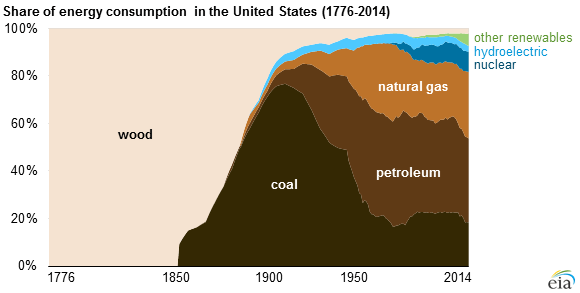
Since the year 1900, fossil fuels have provided at least 80% of the total energy used in the United States (called “Primary Energy”) [9] where the mix is shown in the image below (from [9]). The Energy Information Agency anticipates that this percentage will remain the same through the year 2050 [10]. By 2050, We will have built our economy and lifestyles upon the foundation of fossil fuels for two hundred years. My question for you is this: How long will it take to move that economy to a different foundation and can we do it fast enough? The most significant issue with renewable energy, as I illustrated in my last post, is that it is not concentrated, unlike fossil fuels. This means that transitioning to renewable energy is going to be a big, expensive, time-consuming, political task requiring lots of land; not exactly something that happens overnight.
Chances are we will never actually collect and use all of the fossil fuels trapped within the Earth’s crust. We have already picked most of the low hanging fossil fuel fruits and are starting to get into the hard to reach bits. For example, in 1901 some Texans drilled 1,000 feet into the Earth’s crust and hit oil, gushing out (see picture below) at an approximated 100,000 barrels a day [11]. Today, the average depth of an oil well in the United States is 7,500 feet [12] and these wells produce maybe 1,000 barrels a day [13]. At some point in the future it will become too hard to pump enough oil, meaning that the rate at which we pump oil out of the ground will start to fall below the demand for oil, an event known as “peak oil” [14]. As oil production falls but demand remains the same the price of oil will increase rapidly, causing the price of everything that relies on oil to also increase rapidly. In a similar way, natural gas and coal could also have peak events. Eventually, the cost to extract these resources will become so great that it will no longer be feasible to dig them out of the ground.

Predicting when peak oil will happen is about as easy as predicting the second coming. As soon as gas prices start to rise some expert report is published that predicts that we have hit peak oil, suggesting that everyone run for the doomsday bunker [11]. But, as soon as gas prices go back down everybody forgets about peak oil and life goes on as usual [12]. However, just because it didn’t happen doesn’t mean that peak oil won’t happen, it just means it isn’t happening right now. The very obvious truth remains – there is only so much oil in the ground. We are betting our lifestyles (and lives) on a resource with a certain ending but an unknown timetable. We are making significant withdrawals from nature’s energy savings account and we don’t even know how much is left in the account. This is not wise. True, you and I may never feel the effects of fossil fuel depletion, but our descendants sure will.
Once fossil fuels are depleted, are there any technologies that will no longer be possible? Indeed, there are. Anything that must carry its own fuel and requires an insane amount of power is basically impossible without a highly-concentrated liquid fuel source (coal can be converted into a liquid [13]). For example, consider the airplane. A Boeing 747 consumes about one pound of fuel a second and carries around 154,000 pounds of fuel when fully loaded [14]. Remember our comparison of lithium-ion batteries and gasoline earlier? Using the same conversion (53 pounds of batteries to one pound of jet fuel) we find that an airplane would have to carry about 8 million pounds of batteries to operate. This doesn’t account for efficiency, but you get the idea. Regardless, I think we can agree that electric planes aren’t going to happen. What about construction equipment, cruise ships, tankers, not to mention tanks, fighter jets and battleships? Also, don’t forget about the things that are actually made from fossil fuels, like plastic, roads, crayons, deodorant and fertilizer (a.k.a food) [15].
Hold up, what about tar sands? Revolutionary scientific advances? New recovery techniques? Undiscovered oil reserves? Honestly, all of these things are just delaying the inevitable and making the problem worse. It’s like a class of seventh graders pleading with their teacher to extend the due date of a paper they have completely neglected. She agrees to extend the due date by a week but adds five pages to the assignment. The class happily agrees, but a week later they find that they still haven’t even started the paper. We can plead for another extension, but one day the end of the semester will come. It’s better to write the paper now.
In the end, my message here is very simple. Fossil fuels aren’t inherently bad, but the colloquial saying remains true – “moderation is best in all things.” Instead of increasing our reliance on fossil fuels we should be figuring out how to cut them out of our life, saving them for the purposes that require fossil fuels. Coincidentally, this would dramatically reduce our rate of carbon dioxide and pollutant production, fixing the whole climate change issue, but that’s beside the point.
But what can you do against such powerful economic forces? We are the economy people! We only burn fossil fuels because we require a massive amount of energy to sustain our lifestyles. If we require less energy, we require less fossil fuels. Consider your own consumption and you will happily find plenty of tasks you currently complete with fossil fuels that you can do all by yourself. I mean, do you really need a leaf blower?
Cover Photo Credit: Ed Stein Ink
 Joule Thieves
All the way through your blog I kept thinking about the opposition to new energy technologies, something you fail to mention. The most obvious being cold fusion about which scientists (not oil companies) lied and cheated until it was rejected out of hand by all and sundry. You have to remember that we are living in an age that has more scientists than ever before in the history of the world. They have this problem knocking at their door and their contribution is negative – lucrative jobs are at stake. And when it comes to discussions about pollution they blame us, the plebs for driving our cars to work and heating our homes when it is their own failure to do the things they lead everyone to believe they do.
The fusion reactor has failed to work for something like seventy years, having had shed-loads of tax payers money spent on it. But again this is about endless jobs for the same boys with dodgy theories that will never work.
LikeLike
Thanks for reading! My post about nuclear power is upcoming, and I will make sure to throw cold fusion in there. Science is anything but perfect. Many people think of science as a benevolent god who bestows us with wisdom and knowledge right when we need it. Really though, it is just a group of imperfect people trying to discover what is true and then convince everyone else that they are right. A part of this process is getting the funding you need to carry on your research, and if you can’y convince others that you have something worth researching than the funding won’t happen. The original cold fusion experiment has been shown to be faulty and all subsequent experiments have not been able to replicate the result. Without more evidence, we just don’t have the resources to pour into something that we aren’t sure will work. It would be great though if it worked!
LikeLike
I get the feeling that you only get your cold fusion LENR info from peer reviewed sources? If you Google there are millions of pages. My own experience is that it has been “debunked” – a word that probably has a different meaning for you than it does for me. As is usual, it’s about jobs for scientists rather than “saving the planet” as Hollywood would have us believe.
Anyway, some time ago I researched and wrote several pages that touch on the subject and they tell a completely different story. They may or may not be of interest to you:
https://nextexx.com/suppression-cheap-clean-energy/
https://nextexx.com/alchemy-nightmare-lenr-cold-fusion/
Regards
LikeLike
Thanks for the articles. I’ll make sure to give them a read.
LikeLike