
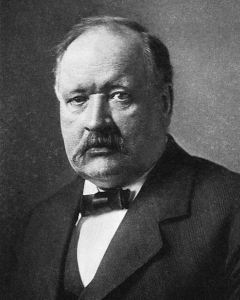
 In 1896, the famous Swedish scientist Svante Arrhenius (pictured to the right) published a widely read article discussing the influence of carbon dioxide on the temperature of the Earth [1]. His conclusion wouldn’t surprise anyone today – if you add carbon dioxide to the Earth’s atmosphere then the temperature of the Earth will increase. Likewise, if you remove carbon dioxide from the Earth’s atmosphere than the Earth’s temperature will decrease. His findings were further corroborated by those of Callendar in the 1930’s [2]. The publications of these findings, however, was not accompanied with mass hysteria, stern warnings of future cataclysmic warming, op-eds to the New York Times about the polar bears or award winning documentaries. Instead, the scientific world mostly celebrated the future warming of the Earth, as depicted by this 1950’s newspaper comic [3].
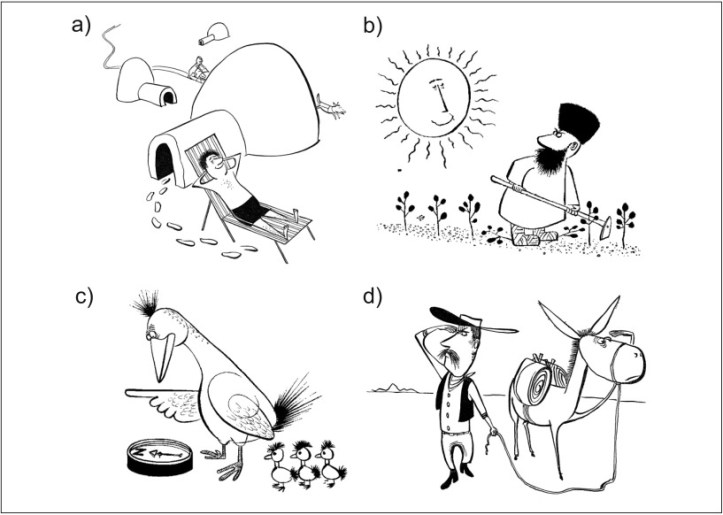
The world was celebrating because these scientists had successfully conquered what they had set out to try and predict – the next ice age. To quote Arrhenius (emphasis my own) [4]:
“We often hear lamentations that the coal stored up in the earth is wasted by the present generation without any thought of the future…. We may find a kind of consolation in the consideration that here, as in every other case, there is good mixed with the evil. By the influence of the increasing percentage of carbonic acid [carbon dioxide] in the atmosphere, we may hope to enjoy ages with more equable and better climates, especially as regards the colder regions of the earth, ages when the earth will bring forth much more abundant crops than at present, for the benefit of rapidly propagating mankind.“
Callendar agreed whole-heartily, anticipating that global warming would stop “the return of the deadly glaciers.” [5].
The fact that ice ages had previously gripped the Earth was a new truth to the academic world, accepted globally only in the 1870’s [6]. Naturally, the scientists of the time were concerned that a new ice age would, as Arrhenius put it, “drive us from our temperate countries into the hotter climates of Africa.” Imagine the relief when it was discovered that burning coal created carbon dioxide, naturally warming the Earth and staving off any future ice ages. It wasn’t until the late 21st century that we started to think about all of the consequences of global warming, not just the convenient results. The world realized that the small, seemingly-insignificant and largely-ignored changes brought on by a warming world would have far-reaching effects.
I’m writing this post today because history has this nasty habit of repeating itself. The scientific world of the early 1900’s embraced fossil fuels mostly because life was much easier when you had coal to burn, but also because burning fossil fuels were an apparent solution to that pesky ice age problem. But, in our attempt to solve an imagined environmental problem we ended up creating a real environmental crisis. Today, we must give up the fossil fuels (for a variety of reasons) but we don’t want to give up the energy we get from those fossil fuels. Instead, we have decided to try and meet our current (and future) consumption entirely with renewable energy, the savior of the 21st century. Although switching entirely to renewable energy is necessary, I fear that we often don’t think about the realities of a world powered entirely by renewable energy. Instead, we just think of a world not powered by fossil fuels. This is obvious in the way we talk about renewable energy. Most words used to describe solar or wind power, such as ‘clean’, ‘renewable’ or ‘green’, are words that just emphasize the benefits of renewable energy over fossil fuels.
I think we perceive renewable energy as entirely harmless because it does not add pollution to the environment. Compared to the belching smokestacks outside of coal and natural gas power plants, a turning wind turbine appears quite harmless. However, in the case of renewable energy, it is not the end result of the process that we have to worry about. Instead, it is the fact that the energy was taken in the first place. You see, just because an energy source is renewable doesn’t mean that things won’t change when you take energy away from that source. Remember the First Law of Thermodynamics, energy cannot be created or destroyed. A turning wind turbine isn’t generating electricity out of nothing – that would be impossible. Instead, the wind turbine is taking energy out of the wind and sending it to your ceiling fan. Removing energy from any resource and expecting that resource to behave exactly the same is like filling up your car with less gas and expecting it to drive just as far.
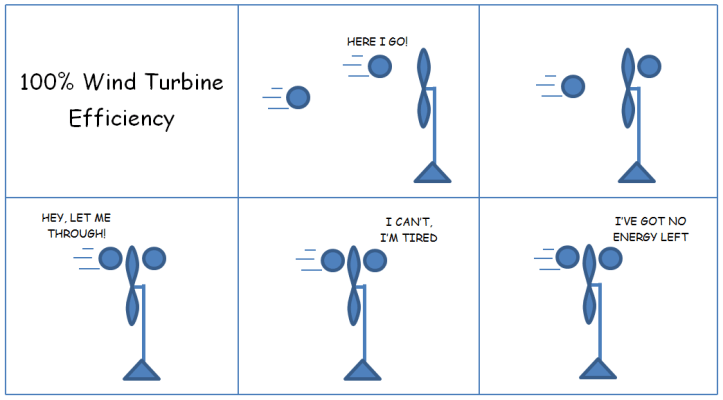
But, we might say, there is so much wind that there is no way we can make a dent! We are just sipping from the ocean! Of course, this is what mankind used to say about the atmosphere and our adding carbon dioxide to it… but I digress. The research is few and far between, but some scientists have studied what a large scale deployment of most renewable energy resources would look like, and I think the results are worth reviewing.
Wind Energy
To power the United States entirely with wind would take 8 million wind turbines, with four million turbines covering an area equal to the state of Alaska and the other four million spread across most of the coastlines of the Earth [10]. Extracting all of our energy from the wind would amount to about 4% of all of the energy present currently in the wind. Although this might seem like a small number, the atmosphere is a complicated fluid system, meaning that everything depends on everything else (you know, that whole butterfly effect thing). Extracting even a small portion of that total energy could change a lot of things. For example, if you plug up even just one sprinkler in your sprinkler system than the behavior of all the other sprinklers will change. So, how will the world change if we plug up a sprinkler? Let see what science has to say…
Most scientific studies concerning the large scale deployment of wind energy have somewhat troubling language in the conclusions sections. To quote a few, “High levels of wind development as contemplated here could result in significant changes in atmospheric circulation even in regions remote from locations where the turbines are deployed.” [11] or “Our analysis suggests that the climatic impacts of wind power may be nonnegligible, but they do not allow a detailed quantitative evaluation of the climatic changes induced by extraction of wind power.” [12] Another paper found that a large variety of wind patterns would change “substantially” as well as an increase in the amount of moisture in the atmosphere and the number of clouds in the sky [13]. My favorite part is how all of these papers brush away these variations to the wind patterns of the Earth by saying, in my own words, “but it isn’t as bad as global warming, so it’s okay.” Do we trust these scientists to anticipate every single outcome of large scale wind energy deployment? Lets see what the researchers have to say on the matter. “A significant amount of future research is required to truly understand the large scale impacts of wind energy,” I’m not so sure we have considered all of the outcomes.
Hydroelectric Power
Hydroelectric power was the poster child of renewable energy for most of the early 20th century. Simply build a dam and run the stopped up water through the turbines and you have clean, emission-free electricity! But, removing energy from a river changes the temperature, flow speed and even the run of the river, modifying the delicate biosphere present in every running body of water [14]. Even hydroelectric power captured through “small hydro” power plants, or hydroelectric power plants that don’t use a dam, pose significant environmental threats once deployed on a large scale [15]. In the end, removing energy from running bodies of water, no matter how we capture it, changes the character of the stream enough to modify the dependent environment. Hydroelectric power should be our go to example of what happens when we extract power from a natural resource without thinking through every consequence.

Solar Energy
When it comes to solar power, energy and land are basically equivalent. So, if you want more energy you need more land. In my first post, I tried to quantify the amount of land we would need to meet the energy demand of the United States and came up with the state of South Carolina. Applying these same calculations to a world of 7 billion people living the lifestyles of Americans, we came up with the country of Libya. As the number of people on the Earth grows and the amount of energy each person consumes increases then the total land area devoted to solar panels must grow to meet this demand.
To make matters worse, large scale solar plants characteristically change the land on which they are placed, effectively eliminating all natural vegetation [16], substantially increasing soil erosion [17], messing around with how the light is absorbed or reflected and even increasing the local temperature by as much as 3 – 4 degrees Celsius [18]. Also, because these power plants are not sited near human developments or popular recreational land, these solar plants tend to pop up near protected wilderness areas [19]. Likewise, several plants in California have listed their installation as representing a “significant impact” on the livelihood of the threatened Desert Tortoise as well as 10 other endangered species [20]. If entire dams can be decommissioned to save the salmon, shouldn’t the same treatment be given to the desert tortoise? Again, and most importantly, all of the papers discussing the environmental impact of large scale solar (and there are few) state that a “significant quantity” of research is still required to truly determine the environmental impact.

I’m sure this article will be perceived as an attack on renewable energy, which it is not. I have hopes to work in the renewable energy industry if that makes you feel any better. Honestly, we have not choice but to switch to renewable energy sometime in the near future. But I think it is important to remember Arrhenius’ error – it is impossible to predict every outcome resulting from the large scale deployment of any energy resource. So far, mankind has tried a variety of methods to utilize large quantities of energy, all of them with good intentions and no perceived negative consequences, only to realize that we hadn’t thought about the polar bears, or the salmon, or the desert tortoise. As it turns out, energy is almost always accounted for in the natural world, even if that energy is just used to move moisture around, keep the air hot or move water from the top of a mountain to the ocean. Removing energy from any system will undoubtedly cause change, but how it will change is the big question that is so very hard to answer.
I’m writing this post to remind the reader that how much energy you use is just as important as where you get that energy from. Reducing consumption is the low-hanging fruit on the tree of environmentalism that we keep forgetting to pick. So, do the desert tortoise a favor and bike to work tomorrow.


![[3]](https://ars.els-cdn.com/content/image/1-s2.0-S0160932716300308-gr6.jpg)
Thanks for the article! Great read.
What about nuclear power – Specifically something like molten salt reactors? I realize they are still somewhat theoretical, but it seems to me that a molten salt reactors poses the least risk to the environment. I’m interested to know your opinion on the matter.
LikeLike
Thanks for reading! Nuclear is such an interesting story that I’m going to give it its own article. Overall, I think we should definitely incorporate more nuclear power into the mix especially as we are trying to phase out fossil fuels. Uranium won’t last forever but nuclear power is an easy substitute for now. There are a surprising number of concerns related to a mass scaling up of nuclear power (this article does a great job of summing them up http://ieeexplore.ieee.org/stamp/stamp.jsp?arnumber=6021978) and we need to consider all of these. Overall, I think we should scale up nuclear but reducing consumption is still absolutely necessary.
LikeLike